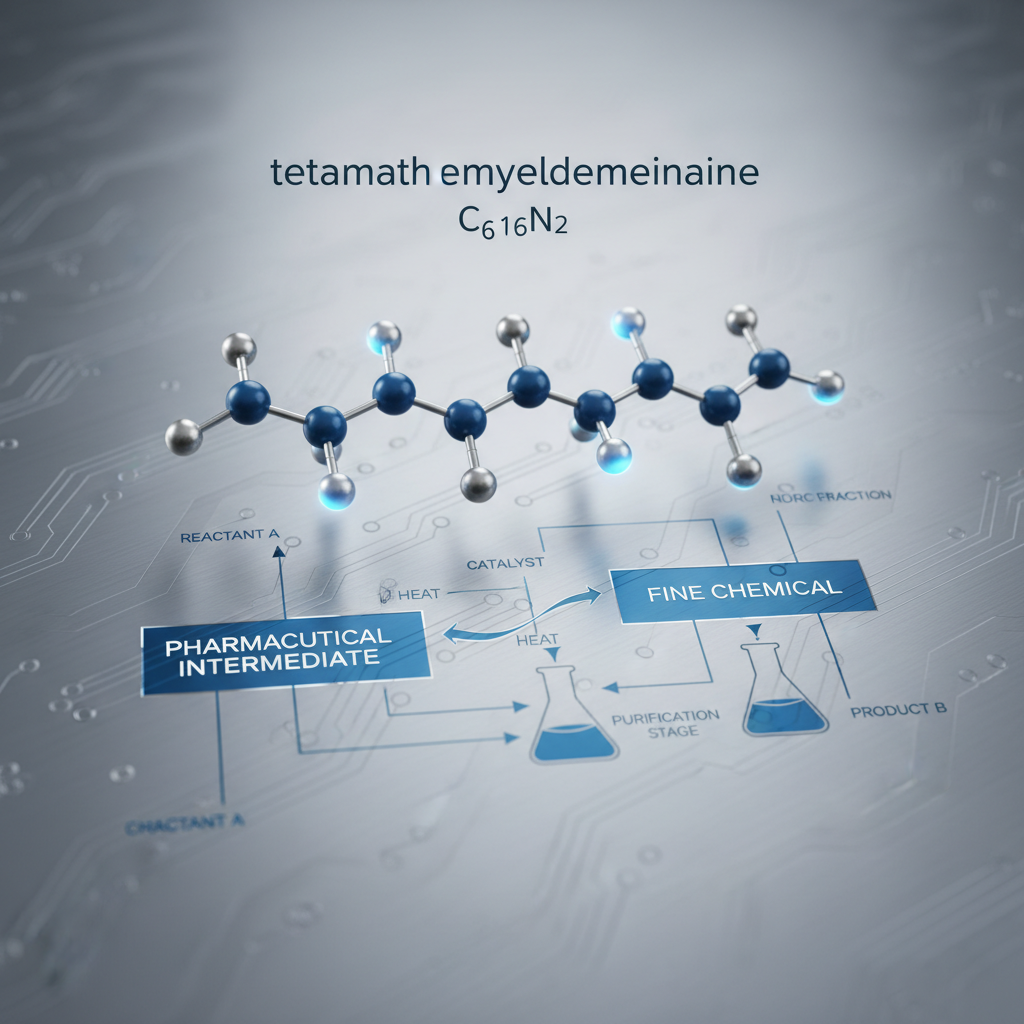
Tetramethylethylenediamine (TMEDA) CAS No. 110-18-9 is a versatile tertiary amine widely utilized as a ligand in organometallic chemistry, a catalyst in polymerization reactions, and a stabilizer in various chemical processes. Its importance stems from its ability to coordinate with metal ions, enhancing their reactivity and solubility. Understanding its properties and applications is crucial for advancements in fields ranging from materials science to pharmaceuticals. Globally, the demand for TMEDA is driven by the growing chemical industry and its reliance on efficient catalytic systems.
The global market for TMEDA, while relatively niche, is experiencing steady growth, particularly in Asia-Pacific due to increasing chemical production in countries like China and India. According to industry reports, the demand is projected to rise alongside the development of new polymerization technologies and the expanding use of organometallic catalysts. However, challenges exist in terms of sustainable production and handling of this potentially hazardous chemical, necessitating continuous innovation in safety protocols and environmentally friendly synthesis methods.
Addressing these challenges is paramount to ensuring the continued availability and responsible application of tetramethylethylenediamine cas no. Its unique chemical characteristics make it irreplaceable in many critical industrial processes, and therefore, ongoing research and development are crucial for optimizing its production and minimizing its environmental impact.
Introduction to Tetramethylethylenediamine CAS No. 110-18-9
Tetramethylethylenediamine (TMEDA), identified by CAS No. 110-18-9, is a colorless liquid with a strong amine odor. Its molecular formula is C8H20N2, and it's a tetraalkylated ethylenediamine. This compound’s primary function lies in its exceptional coordinating ability with metal ions, forming stable complexes that are pivotal in numerous chemical reactions.
The widespread adoption of tetramethylethylenediamine cas no. is largely due to its effectiveness as a ligand, catalyst, and stabilizer. From enhancing the efficiency of Grignard reagents in organic synthesis to improving the performance of polymerization catalysts, its impact on modern chemical processes is substantial. Its versatility makes it an essential component across various industrial sectors.
The Chemical Profile of Tetramethylethylenediamine CAS No. 110-18-9
Tetramethylethylenediamine (TMEDA), CAS No. 110-18-9, is characterized by its four methyl groups attached to the nitrogen atoms of ethylenediamine. This structural feature significantly influences its properties, making it a strong Lewis base and an effective ligand. It's miscible with water and most organic solvents, facilitating its use in a wide range of reaction environments.
Its chemical reactivity stems from the lone pairs of electrons on the nitrogen atoms, which readily donate to metal ions, forming coordination complexes. These complexes can alter the metal’s electronic and steric environment, impacting its reactivity. This principle underpins many of TMEDA’s applications in catalysis and organic synthesis.
Importantly, TMEDA is hygroscopic, meaning it readily absorbs moisture from the air. Therefore, proper storage and handling are crucial to maintain its purity and effectiveness. Maintaining dry conditions ensures that the full catalytic potential of tetramethylethylenediamine cas no. is retained.
Key Properties Influencing Tetramethylethylenediamine CAS No. Applications
Several key properties of tetramethylethylenediamine cas no. drive its diverse range of applications. Its strong coordinating ability, as mentioned earlier, is paramount. Additionally, its relatively low molecular weight and high boiling point (120-122 °C) make it easily manageable in various reaction setups. Its basicity (pKa ≈ 8.6) also plays a vital role in its catalytic activity.
The steric bulk provided by the four methyl groups around the nitrogen atoms influences the geometry and stability of the complexes formed with metal ions. This steric hindrance can selectively favor certain reaction pathways, making TMEDA a valuable tool for controlling the selectivity of chemical transformations. The careful manipulation of steric effects is a core principle in advanced catalysis.
Furthermore, TMEDA’s solubility in both polar and non-polar solvents is a significant advantage, allowing it to be used in diverse reaction media. This versatility broadens its applicability in a vast number of chemical processes, increasing its value to researchers and manufacturers.
Performance Metrics of Tetramethylethylenediamine CAS No.
Evaluating the performance of tetramethylethylenediamine cas no. requires considering several key metrics. The coordination strength, quantified by its formation constant with different metal ions, is a crucial indicator of its effectiveness as a ligand. Higher formation constants generally translate to more stable and reactive complexes.
Catalytic efficiency, measured by turnover frequency and selectivity, is vital when TMEDA is employed as a catalyst or co-catalyst. These parameters reflect the speed and precision with which the reaction proceeds. Furthermore, its impact on reaction yield and product purity also forms essential performance indicators.
Performance Evaluation of Tetramethylethylenediamine CAS No. in Various Applications
Global Applications of Tetramethylethylenediamine CAS No.
Tetramethylethylenediamine cas no. finds application across a diverse array of industries worldwide. In organic synthesis, it serves as a crucial co-ligand in reactions involving organolithium and Grignard reagents, enhancing their reactivity and selectivity. This is particularly significant in the pharmaceutical and fine chemical industries.
Polymer chemistry also relies heavily on TMEDA, utilizing it as a catalyst component in anionic polymerization and other chain-growth processes. This is critical for manufacturing specialized polymers with tailored properties. Furthermore, in analytical chemistry, TMEDA is used as a complexing agent for metal ions in titrations and separations.
Advantages and Long-Term Value of Tetramethylethylenediamine CAS No.
The advantages of utilizing tetramethylethylenediamine cas no. are multifaceted. Its high catalytic efficiency and selectivity translate into reduced reaction times, higher yields, and minimized waste production, leading to significant cost savings. Moreover, its ability to improve the solubility of metal complexes enhances reaction homogeneity and simplifies purification processes.
From a sustainability perspective, its role in enabling more efficient chemical processes contributes to a reduction in energy consumption and environmental impact. Long-term value is further reinforced by its versatility, allowing for its application in various evolving technologies, making it a continually relevant and valuable chemical component.
Beyond purely economic benefits, utilizing TMEDA often leads to safer chemical processes due to its ability to control reaction pathways and prevent undesired side reactions. This contributes to improved workplace safety and reduces the risk of hazardous incidents.
Future Trends and Innovations in Tetramethylethylenediamine CAS No. Utilization
The future of tetramethylethylenediamine cas no. lies in exploring its application in novel catalytic systems, particularly those focused on sustainable chemistry and green synthesis. Researchers are investigating its use in conjunction with earth-abundant metals to replace traditional, more expensive, and environmentally problematic catalysts.
Furthermore, advancements in microfluidic technology and flow chemistry are creating opportunities for utilizing TMEDA in highly controlled reaction environments, leading to increased efficiency and selectivity. The development of supported TMEDA catalysts, where the compound is immobilized on a solid support, is also gaining traction, simplifying catalyst recovery and reuse.
The integration of TMEDA into advanced materials science is another promising area, with potential applications in the synthesis of novel polymers, coordination polymers, and metal-organic frameworks (MOFs). These materials could have applications in areas such as gas storage, separation, and catalysis.
Summary of Factors Affecting Tetramethylethylenediamine CAS No. Effectiveness
| Metal Ion Identity |
TMEDA Concentration |
Reaction Solvent |
Temperature (°C) |
| Lithium |
1.0 M |
Tetrahydrofuran (THF) |
-78 |
| Magnesium |
0.5 M |
Diethyl Ether |
0 |
| Zinc |
1.2 M |
Toluene |
25 |
| Copper |
0.8 M |
Acetonitrile |
50 |
| Nickel |
0.6 M |
Dichloromethane (DCM) |
Room Temperature |
| Aluminum |
1.5 M |
Hexane |
-20 |
FAQS
The primary function of TMEDA is to act as a ligand, coordinating with metal ions to enhance their reactivity and solubility. It forms stable complexes that are crucial for various chemical transformations, particularly in organometallic chemistry and catalysis. This coordination modifies the metal's electronic and steric environment, influencing reaction pathways and improving efficiency. Its ability to chelate metals is pivotal for achieving desired reaction outcomes.
TMEDA is a corrosive and flammable liquid. Handling it requires wearing appropriate personal protective equipment (PPE), including gloves, safety glasses, and a lab coat. Work should be conducted in a well-ventilated area, preferably a fume hood, to avoid inhalation of vapors. Avoid contact with skin and eyes. In case of contact, immediately flush with copious amounts of water and seek medical attention. Proper storage in a tightly sealed container, away from heat and ignition sources, is also essential.
The structure of TMEDA, featuring four methyl groups attached to the nitrogen atoms of ethylenediamine, is central to its effectiveness. The nitrogen atoms possess lone pairs of electrons that readily donate to metal ions, forming coordination complexes. The steric bulk created by the methyl groups influences the geometry and stability of these complexes, selectively favoring certain reaction pathways. This combination of electronic and steric properties makes TMEDA a highly versatile ligand.
In the pharmaceutical industry, TMEDA is widely used as a reagent and catalyst in organic synthesis, facilitating the production of complex pharmaceutical intermediates and active pharmaceutical ingredients (APIs). It enhances the reactivity of organometallic reagents like Grignard reagents, crucial for carbon-carbon bond formation. Additionally, it's employed in the synthesis of heterocyclic compounds, prevalent in many drug structures. TMEDA’s ability to control reaction selectivity is valuable in producing high-purity pharmaceutical compounds.
TMEDA significantly increases both the rate and selectivity of Grignard reactions. By coordinating with the magnesium ion in the Grignard reagent, it breaks up aggregated structures, generating a more reactive monomeric species. This increased reactivity leads to faster reaction rates. Moreover, TMEDA influences the steric environment around the magnesium center, directing the reaction towards specific products and enhancing selectivity. It effectively minimizes unwanted side reactions.
TMEDA is contributing to sustainable chemistry by enabling the use of more efficient and selective catalysts, reducing waste generation and energy consumption. Researchers are exploring its application with earth-abundant metals as alternatives to expensive and environmentally problematic catalysts. Furthermore, the development of supported TMEDA catalysts allows for easier recovery and reuse, minimizing environmental impact. These advancements align with the principles of green chemistry, promoting more sustainable chemical processes.
Conclusion
In summary, tetramethylethylenediamine cas no. 110-18-9 is an invaluable chemical compound with a broad spectrum of applications across various industries. Its unique properties—strong coordinating ability, high solubility, and catalytic efficiency—make it indispensable in organic synthesis, polymer chemistry, and materials science. Understanding its characteristics and optimizing its use are essential for advancing chemical research and development.
Looking ahead, continued innovation in TMEDA utilization will focus on sustainable practices, the development of novel catalytic systems, and exploring its potential in emerging technologies. For further information on tetramethylethylenediamine and its applications, or to discuss your specific chemical needs, please visit our website: tetramethylethylenediamine cas no.