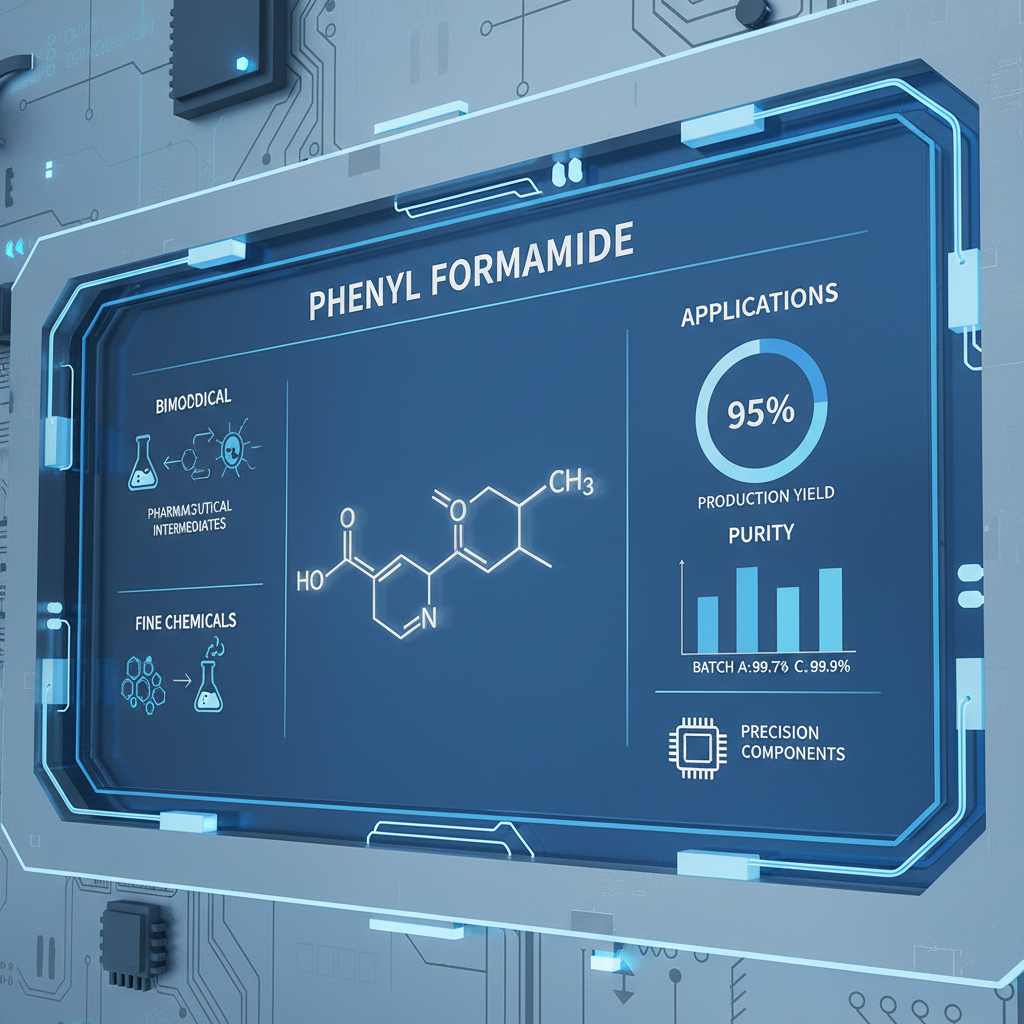
Phenyl formamide, a versatile organic compound, plays a crucial role in a diverse range of industrial applications, from pharmaceutical synthesis to agrochemical production. Its unique chemical properties make it a valuable intermediate in the creation of numerous commercially significant products. Understanding phenyl formamide, its characteristics, and its potential is essential for professionals across the chemical manufacturing landscape. This understanding contributes to innovation and efficiency within the sector, and ensures adherence to stringent quality and safety standards.
The global demand for phenyl formamide is closely tied to the growth of end-use industries, notably pharmaceuticals and pesticides. Emerging economies, with their expanding manufacturing sectors, are becoming key consumers. However, production and handling require adherence to strict environmental regulations and safety protocols. Successfully navigating these challenges demands a deep understanding of the compound's properties and effective risk management strategies.
The increasing need for specialized chemical intermediates in high-growth sectors drives the demand for phenyl formamide. Its relative affordability compared to some alternative compounds, coupled with its versatile reactivity, makes it a preferred choice for many synthetic routes. This positions phenyl formamide as a significant component in supply chains globally.
Defining Phenyl Formamide and Its Significance
Phenyl formamide (CAS number 103-90-2) is an organic compound with the chemical formula C7H7NO. It's essentially a formamide derivative of aniline. At room temperature, it usually appears as a crystalline solid, often colorless or a pale yellow. Its key characteristic lies in its amide functionality, which allows it to participate in a range of chemical reactions, making it a critical building block in various syntheses.
The significance of phenyl formamide extends far beyond its chemical formula. It plays a crucial role in the production of pharmaceuticals, dyes, and agricultural chemicals. Its ability to act as an intermediate allows for the creation of complex molecules with specific properties. Further research into its applications continues to unlock new possibilities in materials science and other innovative fields.
Global Context of Phenyl Formamide Production
The production of phenyl formamide is concentrated in regions with established chemical manufacturing infrastructure, particularly in Asia, Europe, and North America. China currently stands as the largest producer, supplying a significant portion of the global demand. Production is often linked to the availability of aniline, its primary precursor, and to the growth of downstream industries that utilize it.
The United Nations Commodity Trade Statistics database indicates a steady increase in the trade volume of formamides, including phenyl formamide, over the past decade, reflecting its growing importance in global supply chains. The World Bank's data on chemical production indices also supports this trend. The demand is driven by pharmaceutical companies and agrochemical manufacturers who rely on phenyl formamide for the synthesis of active ingredients.
A significant challenge facing the industry is the need to balance production capacity with stringent environmental regulations. Many countries are implementing stricter controls on the handling and disposal of chemical waste, increasing the costs associated with phenyl formamide production. Producers are increasingly investing in sustainable manufacturing processes and waste treatment technologies to address these concerns.
Understanding the Chemical Properties of Phenyl Formamide
Phenyl formamide exhibits several key chemical properties that contribute to its utility in organic synthesis. Its amide group allows it to participate in reactions such as hydrolysis, alkylation, and acylation. It's soluble in common organic solvents like ethanol and ether, but only sparingly soluble in water. Its melting point is around 140-143 °C, a characteristic used in quality control procedures.
The reactivity of phenyl formamide stems from the electron-withdrawing nature of the carbonyl group in the amide linkage. This makes the nitrogen atom susceptible to electrophilic attack. Furthermore, the phenyl ring provides a site for aromatic substitution reactions. These properties enable chemists to tailor the molecule to specific applications through carefully designed synthetic routes. The stability of phenyl formamide is also a critical factor, allowing for storage and handling without significant degradation.
From a safety perspective, it's important to note that phenyl formamide can cause skin and eye irritation. It should be handled with appropriate personal protective equipment (PPE) in well-ventilated areas. Although it is not classified as highly toxic, it is essential to adhere to established safety guidelines for handling chemical intermediates to minimize potential risks. Proper storage in tightly sealed containers, away from incompatible materials, is crucial for maintaining its quality and safety.
Key Applications and Industrial Uses of Phenyl Formamide
Phenyl formamide's primary application lies as an intermediate in the synthesis of various pharmaceuticals. It’s used in the production of drugs targeting diverse conditions, including cardiovascular diseases, neurological disorders, and infectious diseases. The molecule's structure lends itself to modifications that yield compounds with specific therapeutic properties.
Beyond pharmaceuticals, phenyl formamide is a valuable component in the agrochemical industry. It serves as a precursor to herbicides, fungicides, and insecticides. The ability to introduce specific functional groups allows for the creation of pesticides with targeted activity and reduced environmental impact. It also finds application in the production of certain dyes and pigments, particularly those used in textile manufacturing.
Phenyl Formamide Application Breakdown
Worldwide Demand and Regional Consumption Trends
The demand for phenyl formamide is strongly correlated with the growth of the pharmaceutical and agrochemical sectors. Asia-Pacific represents the largest and fastest-growing market, driven by increasing manufacturing activity and a rising population. China, India, and Southeast Asian countries contribute significantly to this demand.
North America and Europe are also substantial consumers of phenyl formamide, primarily due to their well-established pharmaceutical industries and stringent quality standards. However, growth in these regions is relatively slower compared to Asia-Pacific. South America represents a smaller, but steadily growing market.
The Advantages of Using Phenyl Formamide in Synthesis
Phenyl formamide offers several advantages as a synthetic intermediate. Its relatively low cost, compared to other aniline derivatives, makes it an economically attractive option for large-scale production. It’s also highly reactive, allowing for efficient conversion to desired products.
Furthermore, phenyl formamide’s structure provides a versatile platform for introducing various functional groups, enabling the synthesis of complex molecules with tailored properties. Its stability under standard storage conditions simplifies handling and minimizes waste. The wide availability of phenyl formamide from various suppliers also contributes to its widespread adoption.
Future Trends and Challenges in Phenyl Formamide Chemistry
Future trends in phenyl formamide chemistry point towards the development of more sustainable and environmentally friendly production processes. Research is focused on utilizing renewable feedstocks and minimizing waste generation. The application of biocatalysis, employing enzymes to catalyze specific reactions, is gaining traction.
Another emerging trend is the use of flow chemistry, where reactions are carried out in continuous microreactors, leading to improved control, safety, and efficiency. However, challenges remain in terms of scaling up these technologies for large-scale production. Regulatory pressures regarding environmental protection and worker safety will continue to shape the future of phenyl formamide manufacturing.
The development of more selective catalysts and optimized reaction conditions is essential for reducing by-product formation and improving product purity. The integration of digital technologies, such as process modeling and machine learning, can help optimize manufacturing processes and reduce costs.
Summary of Key Considerations for Phenyl Formamide Production and Application
| Production Cost |
Environmental Impact |
Reaction Efficiency |
Regulatory Compliance |
| Low to Moderate |
Requires Waste Management |
Generally High |
Strict Standards Apply |
| Regional Variations Exist |
Sustainable Practices are Essential |
Catalyst Optimization Key |
Globally Harmonized System (GHS) |
| Influenced by Aniline Prices |
Emphasis on Green Chemistry |
Flow Chemistry Enhancements |
REACH and Similar Regulations |
| Economies of Scale Matter |
Lifecycle Assessment Importance |
Minimizing By-product Formation |
Adherence to Safety Protocols |
| Supply Chain Dynamics Impact |
Waste Reduction Strategies Crucial |
Improved Catalyst Selectivity |
Ongoing Monitoring & Reporting |
| Cost Competitiveness is Key |
Circular Economy Principles |
Real-Time Process Control |
Continuous Improvement Needed |
FAQS
Phenyl formamide is frequently used as a key building block in the synthesis of a wide range of pharmaceutical compounds. Its unique chemical structure and reactivity make it an ideal intermediate for creating complex molecules with specific therapeutic properties, particularly within heterocyclic drug development. It's often utilized in the production of active pharmaceutical ingredients (APIs) for treating diverse conditions.
Yes, the production of phenyl formamide can pose environmental challenges due to the potential for waste generation and the use of hazardous materials. The process often involves chemicals requiring careful handling and disposal. Sustainable manufacturing practices, including waste reduction, solvent recycling, and the use of cleaner production technologies, are increasingly crucial to mitigate these concerns. Adherence to environmental regulations is paramount.
Phenyl formamide can cause skin and eye irritation, therefore, it’s essential to wear appropriate personal protective equipment (PPE), including gloves, safety glasses, and a lab coat, when handling it. Work should be conducted in a well-ventilated area to minimize exposure to vapors. Proper storage in tightly sealed containers, away from incompatible materials, is also crucial. Refer to the Safety Data Sheet (SDS) for detailed safety information.
Aniline is the primary precursor to phenyl formamide, therefore, its price has a significant influence on the cost of phenyl formamide production. Fluctuations in aniline prices, driven by factors like crude oil prices and supply-demand dynamics, directly impact the overall cost of producing phenyl formamide. Monitoring aniline market trends is crucial for managing costs effectively.
Key quality control measures for phenyl formamide include assessing its purity using techniques like gas chromatography-mass spectrometry (GC-MS) and high-performance liquid chromatography (HPLC). Melting point determination is another important QC parameter. Moisture content, acidity, and color are also routinely checked to ensure compliance with product specifications. Rigorous analytical testing is essential for maintaining consistent quality.
Emerging trends include a shift towards more sustainable production methods, like utilizing biocatalysis and flow chemistry to reduce waste and improve efficiency. Research is also focused on developing novel catalysts that enhance reaction selectivity and yield. The integration of process analytical technology (PAT) for real-time monitoring and control of production parameters is gaining traction to optimize processes and enhance product quality.
Conclusion
In conclusion, phenyl formamide remains a vital intermediate across numerous industries, particularly in the pharmaceutical and agrochemical sectors. Its versatile chemical properties, coupled with its relatively low cost, ensure its continued importance in complex chemical syntheses. Understanding its production, applications, and associated challenges is crucial for professionals in these fields.
Looking ahead, the future of phenyl formamide lies in the development of more sustainable and efficient production processes. Embracing green chemistry principles, investing in innovative technologies like flow chemistry and biocatalysis, and prioritizing rigorous quality control measures will be paramount. For reliable supply and expert support, visit our website at phenyl formamide.