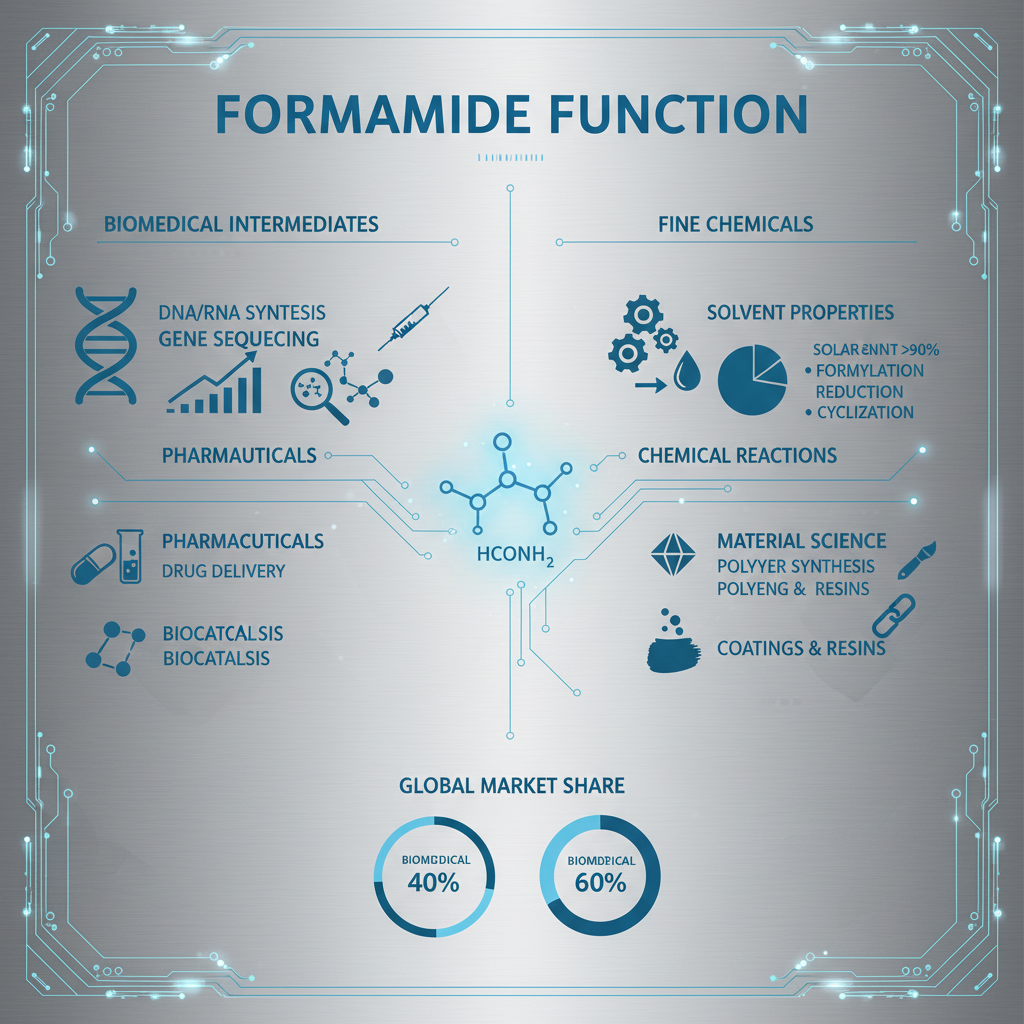
Understanding the versatile formamide function is essential for professionals in the organic chemical industry, as this unique solvent and intermediate plays a pivotal role in various synthesis processes. From its ability to dissolve a wide range of polar compounds to its utility as a raw material for pharmaceutical precursors, its chemical flexibility makes it indispensable in modern manufacturing.
Globally, the demand for precise chemical intermediates has surged, placing a spotlight on the efficiency and stability provided by the formamide function in high-pressure and high-temperature environments. Whether it is used in the production of herbicides or as a denaturant for proteins in laboratory settings, its ability to facilitate complex reactions ensures higher yields and purity for end products.
By exploring the technical nuances of the formamide function, businesses can optimize their production lines and reduce waste, aligning their operations with global sustainability goals. This comprehensive guide aims to break down the mechanical and chemical properties of formamide, providing a roadmap for its effective application across diverse industrial sectors.
Global Relevance of Formamide Function
On a global scale, the formamide function is a cornerstone of the organic synthesis industry. According to chemical trade data and ISO standards for organic solvents, the versatility of formamide allows it to serve as a bridge between basic raw materials and high-value specialty chemicals. Its ability to act as a polar aprotic solvent makes it vital for pharmaceutical companies worldwide, particularly in the synthesis of heterocyclic compounds.
However, the industry faces a constant challenge in balancing high reactivity with safety and environmental regulations. The precision of the formamide function must be managed carefully to prevent degradation and ensure that the final product meets the rigorous purity standards required by international healthcare and agricultural regulatory bodies.
Definition and Chemical Meaning
In simple terms, the formamide function refers to the specific chemical behavior and utility of the amide group derived from formic acid. This functional group allows the molecule to engage in hydrogen bonding and polar interactions, making it an exceptional solvent for substances that are otherwise difficult to dissolve, such as certain polymers and inorganic salts.
Beyond its role as a solvent, the formamide function serves as a vital intermediate in the production of various nitrogen-containing compounds. In the context of modern industrial needs, this means it can be used to "mask" certain reactive sites during a chemical reaction, ensuring that the synthesis proceeds in a controlled, linear fashion without unwanted side reactions.
From a humanitarian and economic perspective, the efficiency of the formamide function directly impacts the cost of essential medicines and crop-protection agents. By reducing the number of steps required in a complex synthesis, it allows manufacturers to bring critical products to market faster and more affordably.
Core Components of Its Performance
One of the primary pillars of the formamide function is its Solvency Power. Because of its high dielectric constant, it can stabilize transition states in organic reactions, which significantly lowers the activation energy required for the process to occur.
Thermal Stability is another critical aspect of the formamide function. It can withstand moderately high temperatures without decomposing, which is essential for industrial-scale reflux reactions where consistent heat is required to maintain the reaction rate.
Finally, the Chemical Scalability of the formamide function ensures that a process developed in a small laboratory beaker can be transitioned to a 10,000-liter industrial reactor without losing the specific purity or yield characteristics of the chemical reaction.
Industrial Applications and Use Cases
In real-world contexts, the formamide function is applied extensively in the synthesis of pesticides and herbicides in agricultural hubs like Brazil and the US Midwest. By acting as a precursor, it enables the creation of targeted chemicals that protect crops while minimizing the environmental footprint, showcasing a balance between industrial productivity and ecological care.
Furthermore, in specialized industrial zones, the formamide function is utilized in the production of polyurethane foams and as a denaturant in biochemical research. For instance, in the preparation of DNA and RNA samples, formamide is used to lower the melting temperature of the double helix, allowing scientists to analyze genetic sequences with unprecedented accuracy.
Comparative Efficiency of Formamide Function Methods
Tangible Advantages and Long-term Value
The most tangible benefit of leveraging the formamide function is the significant reduction in operational costs. By optimizing the solubility of reactants, manufacturers can use smaller volumes of solvent and achieve faster reaction times, which directly translates to lower energy consumption and increased throughput.
Beyond the logic of cost, there is a strong emotional value in the reliability and safety it brings to the lab. When a chemical process is predictable and stable—thanks to the consistent performance of the formamide function—it fosters a culture of innovation and trust among R&D teams, allowing them to push the boundaries of what is possible in organic chemistry.
Future Trends in Chemical Innovation
As the industry pivots toward "Green Chemistry," the formamide function is being reimagined. New research is focusing on bio-based formamide derivatives that maintain the same high efficiency but are derived from renewable feedstocks rather than petrochemicals, aligning with global carbon-neutrality goals.
Digital transformation is also playing a role. The integration of AI-driven molecular modeling allows chemists to simulate the formamide function in a virtual environment before ever touching a flask. This "In Silico" approach reduces waste and accelerates the discovery of new pharmaceutical intermediates.
Furthermore, the trend toward automation and flow chemistry is enhancing the way the formamide function is utilized. Continuous flow reactors allow for better heat management and pressure control, maximizing the effectiveness of formamide while minimizing the risk of hazardous runaway reactions.
Overcoming Challenges in Implementation
Despite its advantages, a common limitation is the potential for toxicity and the strict handling requirements associated with the formamide function. To overcome this, leading companies are implementing closed-loop recovery systems that capture and recycle formamide, preventing it from entering the environment.
Another challenge is the sensitivity of certain formamide-based reactions to moisture. The professional solution involves the use of advanced molecular sieves and nitrogen-blanketed reactors, ensuring an anhydrous environment that preserves the integrity of the formamide function throughout the synthesis cycle.
Expert insights suggest that the key to successful implementation lies in employee training and the adoption of rigorous EHS (Environment, Health, and Safety) protocols. By prioritizing safety and precision, firms can unlock the full potential of this chemical tool without compromising worker health or environmental integrity.
Analysis of Formamide Function Implementation Across Different Industrial Scales
| Implementation Scale |
Primary Formamide Function |
Efficiency Score (1-10) |
Risk Mitigation Strategy |
| Laboratory R&D |
Molecular Probing |
9.5 |
Fume Hood Extraction |
| Pilot Plant |
Process Optimization |
8.0 |
Closed-loop Sampling |
| Full-Scale Factory |
Mass Synthesis |
7.5 |
Automated Scrubber Systems |
| Specialty Pharma |
Intermediate Masking |
9.0 |
HPLC Purity Monitoring |
| Agrochemicals |
Precursor Generation |
8.5 |
Waste Neutralization |
| Polymer Science |
Polymer Dissolution |
7.0 |
Temperature Regulation |
FAQS
The primary formamide function is to act as a high-polarity aprotic solvent and a versatile intermediate. It allows for the dissolution of polar compounds and provides a chemical bridge for creating complex nitrogen-containing molecules, such as those found in pharmaceuticals and agrochemicals, while stabilizing reaction intermediates.
Yes, formamide exhibits relatively high thermal stability compared to many other organic solvents. This allows it to be used in reactions requiring heat to drive the synthesis. However, it is always recommended to monitor for decomposition products if temperatures exceed standard industrial operating limits.
It reduces costs by increasing the efficiency of the reaction. Higher solubility of reactants leads to faster reaction rates and higher yields per batch. When combined with recovery systems, the formamide function enables a lean manufacturing process that minimizes waste and energy expenditure.
While traditional formamide is petrochemical-based, the industry is moving toward bio-derived versions. By integrating the formamide function with sustainable sourcing and closed-loop recycling systems, companies can significantly reduce their environmental impact while maintaining industrial performance.
The main risks involve potential toxicity and sensitivity to moisture. These are managed through the use of professional PPE, sophisticated ventilation systems, and anhydrous reaction conditions (such as nitrogen purging) to ensure that the formamide function operates safely and effectively.
Formamide is the simplest amide, derived from the smallest carboxylic acid (formic acid). This gives it a uniquely small molecular size and high polarity, allowing it to penetrate molecular structures and dissolve substances that larger amides, like DMF or DMAc, might handle differently.
Conclusion
In summary, the formamide function is far more than a simple chemical property; it is a strategic tool that drives efficiency in the pharmaceutical, agricultural, and polymer industries. By providing exceptional solvency, thermal stability, and versatile intermediate capabilities, it enables the production of high-purity chemicals that are essential for global health and food security.
Looking forward, the evolution of the formamide function will likely be defined by the intersection of green chemistry and digital automation. We encourage industry professionals to adopt sustainable recycling practices and AI-driven modeling to maximize the utility of this chemical while minimizing environmental risks. For high-quality chemical solutions, visit our website: www.sincerechemicals.com.